Every first-time shooter who walks onto a range hears it within the first few minutes. Range officers enforce it without exception. Instructors drill it before a single round is fired. And yet, it remains one of the most misunderstood safety concepts in all of recreational and defensive shooting.
The 180-degree rule is not a suggestion, a courtesy, or an optional guideline. It is the hard boundary that keeps everyone on a range alive. Break it even once, and most ranges will end your session on the spot and potentially ban you from returning.
After six years of teaching in South Florida and over two decades of carrying concealed, the number of new students who arrive not fully understanding this rule is still surprising. That is not a knock on them. Nobody is born knowing range protocol. That is exactly why this post exists.
Let’s walk through it clearly, so that whether you are a brand-new gun owner or someone who has been shooting casually for years, you leave here with a complete picture.
The Basic Definition
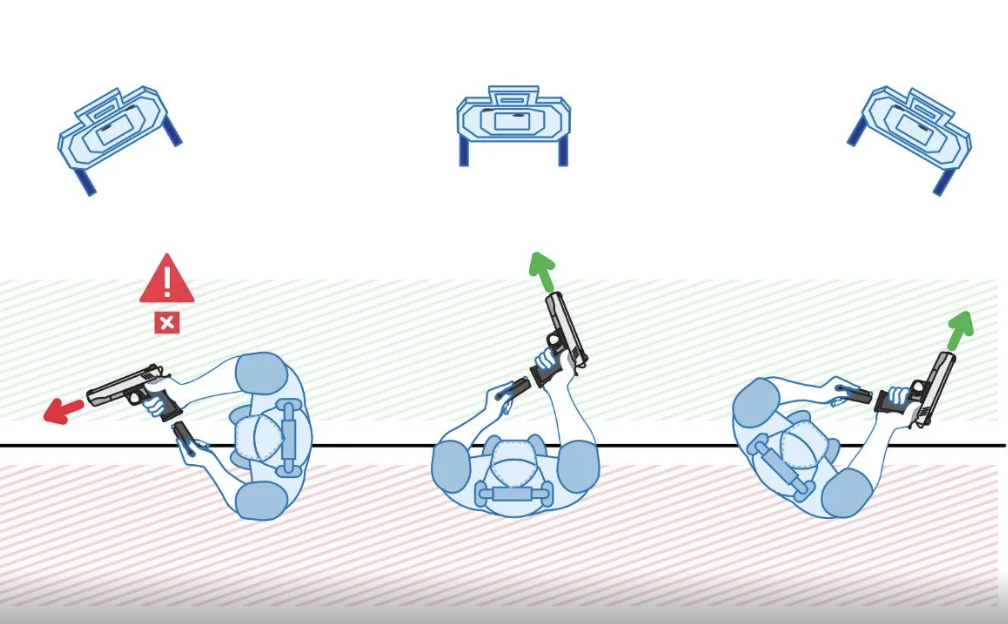
The 180-degree rule is a muzzle discipline standard that means your firearm’s barrel must never sweep past the 180-degree plane that runs from one side of the range to the other, parallel to the firing line.
Think of it this way: imagine a straight line drawn across the range at the point where you are standing. That line runs left to right at your feet, perpendicular to the targets downrange. The 180-degree rule says that your muzzle must always stay on the downrange side of that line. It should never cross it, not even for a fraction of a second.
Visual Reference: The 180-Degree PlaneSAFE ZONE — DOWNRANGEDANGER ZONE — BEHIND THE LINE— THE 180-DEGREE PLANE —YOUMUZZLE ✓Pointed downrangeVIOLATION ✗Muzzle swept behind lineTARGETTARGET
The red dashed line represents the 180-degree plane. Your muzzle stays in the green zone. Always.
Why the Rule Exists
Shooting ranges, by design, place all shooters in a line facing downrange. The berms, baffles, and bullet traps are built to handle rounds traveling in one direction: away from the shooters and toward the targets.
When a muzzle crosses the 180-degree plane and points back toward the firing line, those safety systems become irrelevant. There is nothing between that muzzle and the people standing beside you, behind you, or anywhere in that half of the range.
Ranges are built for rounds going one direction. The moment a muzzle crosses that line, every piece of safety infrastructure on the property stops working.
This is also why the rule applies just as strictly in training drills, competition stages, and tactical courses. The shooting environment changes. The physics of a bullet traveling toward occupied space do not.
Common Ways Shooters Break the Rule (Without Realizing It)
Most violations are not reckless. They come from unfamiliarity or a momentary lapse in awareness. Here are the situations that come up most frequently on the range:
- Turning with the gun in hand. A shooter finishes a string of fire, starts to turn toward the instructor or a shooting partner, and the gun swings with their body. This is probably the single most common violation seen on the line with new students.
- Picking up a dropped item. A magazine hits the deck, and instinct kicks in. The shooter bends down while still holding the gun and the muzzle drifts sideways or backward.
- Holstering with poor technique. At certain angles, especially when someone is not yet comfortable with their holster, the muzzle can sweep past the plane during the reholstering motion.
- During malfunction drills. Clearing a stuck round or a double feed sometimes involves manipulating the gun in ways that can pull attention away from where the muzzle is pointing.
- Moving laterally on the line. Stepping to reach gear or shifting position while still holding the firearm can result in a sweep if the shooter is not actively tracking the muzzle.
⚠ Important Note for New Shooters
Breaking the 180-degree rule at most ranges in Palm Beach and Broward counties results in an immediate cease-fire call and possible removal from the range. At private or tactical training facilities, it can end the session entirely.
A good instructor will correct the issue before it becomes a habit, not embarrass you in front of the group. If you are unsure about any movement, ask before you make it.
The Rule at Indoor vs. Outdoor Ranges
The 180-degree rule applies universally, but the practical stakes vary slightly depending on the environment.
At a typical indoor range in South Florida, shooters are separated by partitioned lanes. The physical structure helps enforce muzzle discipline passively. That said, the rule still applies completely during holster work, during transitions, and any time the shooter steps back from the line.
At an outdoor tactical facility like the private range used in Okeechobee, the environment is more dynamic. Shooters may be moving through stages, engaging targets at multiple angles, drawing from concealment, and working through realistic defensive scenarios. In those environments, muzzle awareness has to be internalized as reflex, not just a rule read off a poster.
Outdoor and tactical training is where you find out whether the habit is truly built or just theoretical. That is one of the reasons more advanced coursework is offered at both types of facilities, so students can develop that situational muzzle awareness in a controlled but realistic setting.
How the 180-Degree Rule Connects to the Four Fundamental Safety Rules
Some students see the 180-degree rule as its own standalone concept. It is not. It lives directly inside the second of the four fundamental firearm safety rules: never point the muzzle at anything you are not willing to destroy.
The Four Fundamental Rules of Firearm Safety
- Treat every firearm as if it is loaded.
- Never point the muzzle at anything you are not willing to destroy.
- Keep your finger off the trigger until your sights are on target and you have made the decision to fire.
- Know your target and what is beyond it.
The 180-degree rule is rule number two applied to the range environment. The other shooters standing on that line are not targets. They should never have a muzzle pointed in their direction, even for an instant.
Understanding this connection matters because it shifts the mindset. Muzzle discipline is not a checklist item. It is an expression of how seriously the responsibility of handling a firearm is taken.
How to Build the Habit So It Becomes Automatic
Knowing the rule intellectually is step one. Internalizing it as muscle memory is the actual goal. Here is what works:
Keep your eyes on the muzzle during every transition.
Any time the gun moves, know exactly where it is pointed. This sounds obvious, but under the pressure of a timed drill or a new technique, that awareness is often the first thing that slips. Train slow, train deliberate, and let speed come naturally after the mechanics are solid.
Develop a consistent low-ready position.
When a string of fire ends, the muzzle goes down toward the ground at roughly a 45-degree angle, not to the side and not rearward. From low-ready, the muzzle is still safely downrange even as the shooter relaxes, communicates, or reloads.
Practice the draw and reholster slowly at first.
These two movements are where new students are most vulnerable to a 180 violation. Work through them at dry-fire speed before ever combining them with live ammunition at a range. Many training courses dedicate significant time to this specifically because it matters that much.
Get a correction the first time, not the fifth.
If a range officer or instructor calls out a muzzle direction issue, stop, acknowledge it, and reset. Do not try to correct on the fly mid-movement. Clear the problem, understand what caused it, and rebuild the movement correctly.
What Happens When the Rule Is Broken
Consequences vary by venue. At a public range, a first violation usually results in a cease-fire call and a verbal correction. A second violation at most ranges in Palm Beach and Broward counties will end the session. Some facilities are less lenient and will remove a shooter after one incident, particularly if it is severe or if others were put at risk.
In a class setting, a violation pauses everything. Safety is addressed before anything else continues. This is not punitive. It is the only responsible way to run a course where students are handling live firearms around each other.
The 180-degree rule does not bend for experience level, for competition history, or for how long someone has been shooting. It applies to every shooter, every time, without exception.
It is worth being direct about something: the rule does not bend for experience level, for competition history, or for how long someone has been shooting. Experienced competitors have been removed from stages for 180 violations. Professional-level training does not exempt anyone from the basics. If anything, the higher the skill level, the less tolerance there is for this type of safety failure.
Questions New Students Ask Most Often
Does the 180-degree rule apply during dry-fire practice at home?
The rule is specific to live-fire range environments where other people are present. At home, dry-fire practice should follow the four fundamental safety rules in full: treat the firearm as loaded, keep it pointed in a safe direction at all times, keep the finger off the trigger until ready to fire, and know what is beyond the target. Safe direction in a home environment typically means toward an exterior wall or a purpose-built dry-fire target, away from occupied rooms.
What if the range target is at an angle?
The 180-degree rule is measured from the firing line, not from the target. Even if a target is positioned at an angle, the plane remains the same. The muzzle must stay on the downrange side of that plane regardless of target placement.
What about when instructors demonstrate manipulations?
Good instructors demonstrate manipulations with the muzzle still controlled downrange or with an unloaded, cleared firearm in a context where everyone present is fully aware of what is being shown. Demonstration is not an exception to muzzle discipline. It is an opportunity to model it correctly.
The Bottom Line
The 180-degree rule is the line between a safe shooting environment and a dangerous one. It is not enforced because range officers enjoy stopping sessions. It is enforced because a firearm pointed toward occupied space is a preventable risk, and preventable risks have no place in a shooting environment.
Learning this rule and internalizing it before showing up to a first class or a first range visit is one of the most respectful things a new shooter can do for the people around them. It signals that the responsibility that comes with firearms is understood.
For anyone preparing to take a first firearms course, a concealed carry class, or a more advanced defensive shooting course in South Florida, this concept will be covered in depth before the first live round is ever fired. The goal is always the same: every student leaves safer than they arrived, with habits that protect themselves and everyone around them.
Mike — Suburban Protector
NRA Certified Pistol Instructor • Tactical Hyve Level 1 • Stop the Bleed Instructor • USCCA Member • 20+ Years Concealed Carry
Based in Boynton Beach, Suburban Protector offers firearms training across Palm Beach and Broward counties as well as a private tactical facility in Okeechobee. Courses range from beginner fundamentals to advanced concealed carry concepts. View upcoming courses.